fbpx Master’s Degree Preferred | HowlRound Theatre Commons

Master’s Degree Preferred

The first time I auditioned for Columbia University’s MFA in directing, the room pulsed with risk and rigor. Over roughly thirty-two sleepless hours, a group of strangers from across the world became an ensemble—building trust, failing spectacularly, surprising each other, and then trying again. We sweated, we laughed, we mourned, we rallied, we reached past language into something physical and real. The electricity wasn’t in the “competition” of it; it was in the collaboration, the sense that something larger than any one of us was being tested, and the current of cultural and personal experiences exchanged in real time and space, together.

Theatre holds the very tools we need most right now: presence, collaboration, imagination, and the courage to risk together. The problem is, those tools are too often locked behind gates—degrees, tuition, hierarchies. The question isn’t whether theatre has value. It’s how we make its knowledge accessible to everyone, everywhere. Now.

Looking back, the chapters of my journey as a theatremaker feel like cards laid on a table, each one a marker of risk, loss, and possibility. The North Star, The Forge, The Gate, The Scales, The Dawn, The Circle, The Fracture, The Commons. Together they form a kind of deck—a tarot for the new age of theatre. For now, these cards rise from my own story and practice, from conversations I have been having. But the deck doesn’t belong to me alone. It could—and should—become a wide circle of practice, a commons built around archetypes we can all hold, reshuffle, and lay down together.

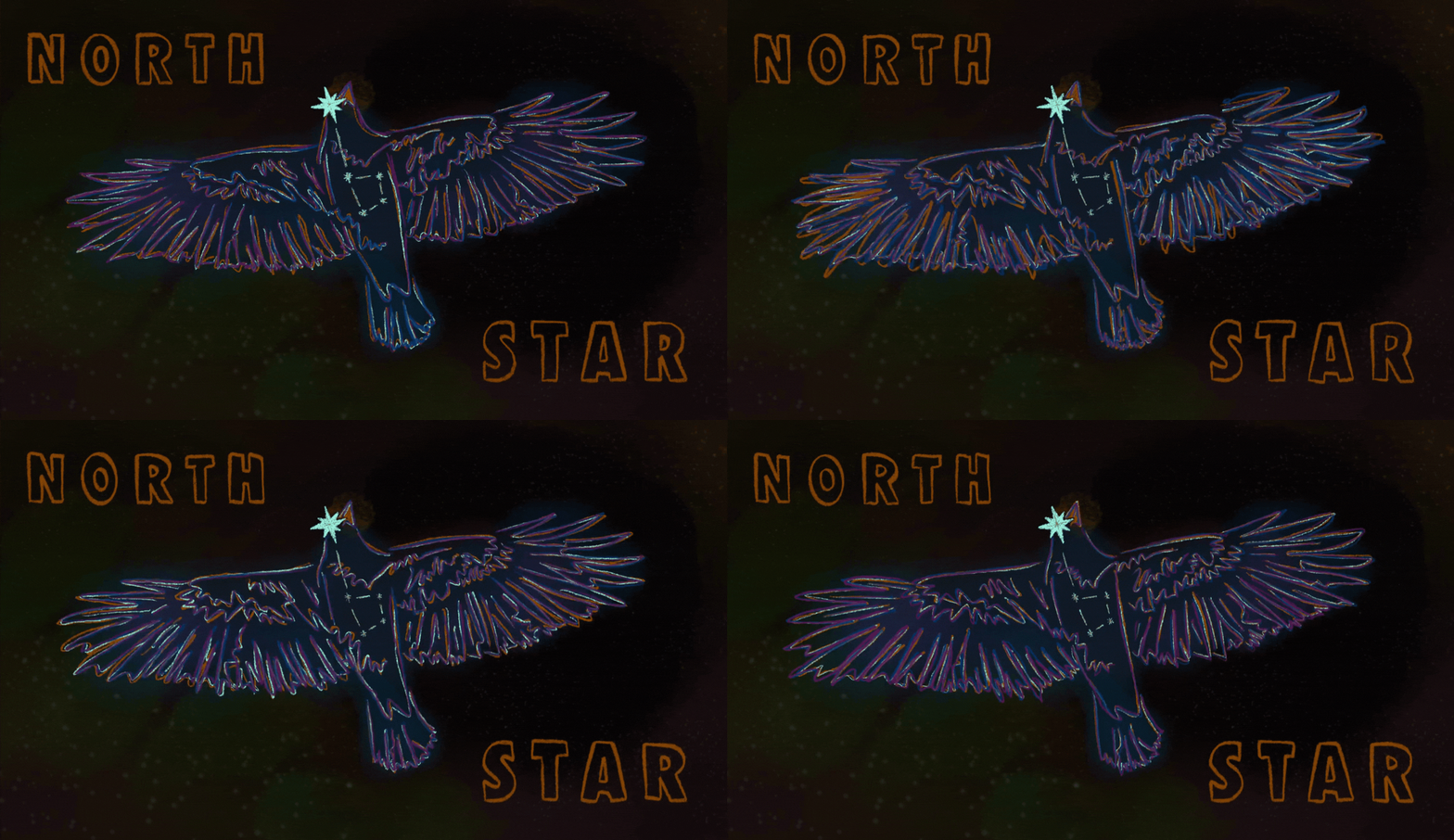
An image of a bird and the words North Star.

Illustration by Jay Eddy. Click to view an animated version.

The North Star

For years, Columbia’s MFA in directing was my North Star. Long before I got there, I was a teenager opening Anne Bogart’s A Director Prepares, floored and electrified by the possibility it sparked. When I learned Anne taught at Columbia, I promised myself: I will find a way in.

So, I hustled. I carved a path through the gatekeepers by first working as a carpentry apprentice at Seattle Rep, then making props by day at Intiman Theatre and directing scrappy work by night. I had energy, I had just enough money to cover living expenses, and I was driven by that dream credential. I told mentors I wanted to be a director—after I’d already been directing since I was fifteen—and was told my best bet was an MFA in stage management. I refused. I wanted to be a director. I was already a director. I wanted to teach. I was teaching. Still, I carried the secret conviction that only Columbia’s credential could make it legitimate.

When I applied to Columbia the first time, colleagues in Seattle staged an impromptu intervention: “But you could just stay here and keep making work.” And they were right—I could have. But I wasn’t interested in just doing anything. I was hungry for rigor, for challenge, for the fire of being pushed past what I thought possible. I had already begun working with SITI Company and spending more time in New York City working as a dramaturg. The hunger I felt in myself was reflected, tested, amplified. I couldn’t turn away from that.

I auditioned not once but twice. I was waitlisted both times. Still, I persisted. I carried the sting of rejection and the hunger of hope into every rehearsal room I entered. I wasn’t let in easily, and once I was in I happened to get a small life insurance payout from my dad passing, which afforded me some space to breathe into the time with mourning and ritual and faith in communal storytelling as sacred practice. A place to practice belief.

An image of a lizard and the words The Forge.

Illustration by Jay Eddy. Click to view an animated version.

The Forge

When I finally arrived, Columbia was not just my North Star—it was my Forge. It burned me, scarred me, honed me, and gave me tools I still use today. But the fire that shapes can also wound.

Halfway through my studies, I was drugged and raped. That act of violence stole the very time I thought I had bought for myself. For months, I tried to keep going. Eventually I reported it—not just for myself, but because I discovered he was a serial offender, and I knew I had to do whatever I could to stop him. What followed was not a healing process. Instead, it felt like a Columbia-led trial, and it dominated my last year in the program. Even inside the room I had dreamed of, institutions were better at protecting themselves than protecting people.

Naming this here isn’t about bitterness, but honesty. I loved my MFA. I hated parts of it. Both truths sit side by side, forged together in heat and pressure. That’s what theatre does: It holds contradictions until they burn into something stronger.

The untrained impulse and the trained craft, held together, make theatre durable.

I don’t regret my MFA—I celebrate it. The rigor, the collaboration, the demand for presence: Those gifts shaped me. The people I met there are a form of family. But what I’ve learned in the ten years since is just as formative: How to survive on the road. How to build productions with no budget. How to sit in living rooms and treat that space as sacred as a studio or Broadway house. Graduate school honed my artistry; the world before and after graduate school sharpened my resilience.

To create a theatre that thrives, we need to honor both kinds of knowledge: the formal and the improvised, the academic and the lived. Some say they were at their best when raw, untrained, visceral. I don’t doubt that, but the tools forged in intense training are invaluable when combined with that rawness. The untrained impulse and the trained craft, held together, make theatre durable.

The Gate

I’ve seen how exclusion works even inside the training ground. I taught as part of an incredible team in the Columbia University Summer Immersive Program for ten years. Our high school students who commuted and couldn’t afford on-campus housing were not allowed to join their peers at the culminating social “dance.” It was a devastating truth for high schoolers and illuminated the cracks in, well, everything. Access was always uneven. Those with housing or family resources were welcomed into the fold. Those without were kept at the margins. Multiply that by tuition, geography, race, class—you see how the job description mainstay “Master’s degree preferred” becomes less a preference than a gate.

A colleague of mine said recently: “In theatre, it is better to be lucky than talented.” The statement stung. Who you know, what city you land in, whether you get in the room—these chances too often eclipse talent. When we use credentials as a proxy for talent, we confuse luck with worth.

An image of two fish and the word scales.

Illustration by Jay Eddy. Click to view an animated version.

The Scales

Here’s the bigger truth: It’s not you, it’s the system. As The View From Here: Producing Artists in the American Theater Today, organized, researched, written, and presented by The Brooklyn Commune Project, reminds us, art will never pass the market test. It is a public good, like clean air, healthcare, or education. It will always cost more than capitalism wants to pay, because its value does not come from efficiency but presence, imagination, and human connection. That’s why artists are underpaid and overextended That’s why MFA programs cost a fortune but can’t promise jobs. That’s why so many of us are told we’re “bad with money” when in fact the economics were rigged from the start.

The economist’s term for this is cost disease. As Nic Bencerràf mentioned in our conversation, it takes as long to rehearse Hamlet today as it did four hundred years ago. The same is true for education, healthcare, any work that depends on intimate collaboration presence and attention. What grows more expensive is not the lumber or the lights but the labor of presence itself. Relative to everything else in the economy, theatre will always cost more, not because we are failing but because our labor is human.

What we do in our rehearsal rooms, classrooms, and community spaces might be less about producing shows and more about creating a toolkit for survival—a set of practices that teach us how to see each other, risk together, collaborate across difference.

And we’ve seen what happens when you take the cost out of the equation. Nic, who taught directing in the Brown University /Trinity Rep MFA program, mentioned that when the university made its program tuition-free, he witnessed their student body diversify in real time. The experiment worked—access widened; perspectives shifted—but now that program is dissolving before our eyes. Even our most promising models of equity are treated as temporary. What does that say about where our priorities really lie?

And let’s be honest: MFA programs, especially the prestigious ones, have long been built on whiteness and hierarchy. Who gets in, who feels at home, whose aesthetics are validated—it’s all shaped by systemic bias. Brown’s experiment proved what happens when you take tuition out of the equation: The room changed. The stories changed. That’s what equity in training can look like, if we’re brave enough to sustain it.

An image of a wolf and the word Dawn.

Illustration by Jay Eddy. Click to view an animated version.

The Dawn

Here’s the urgency: This knowledge is disappearing. The embodied practices of being in a room together, of building trust through risk, of pushing past comfort into presence— these are forms of tacit knowledge, passed body to body, that can’t be uploaded, streamed, or replaced by digital connection. These are not data points, but muscle memory, relational knowledge that fades when not practiced, as educators have demonstrated in hybrid training environments. Nic calls it writing “notes for a future renaissance”: preserving the things we will desperately need to remember if another cultural dark age arrives. And Nic is right. Their words stuck me: We need to preserve the practices of gathering, risk, and presence now, so that if another cultural dark age comes, we’ll have the tools to spark a renaissance. If all human-to-human endeavors are under attack—from education to healthcare to theatre—then we must decide, right now, how to breathe life into what remains.

It reminds me of Emily St. John Mandel’s Station Eleven: After society collapses from a pandemic, a ragtag troupe of actors travels with the motto “Survival is insufficient.” Theatre becomes the way people remember how to be human. That isn’t just fiction—it’s a warning and a blueprint. If another dark age comes, will we have preserved enough of this practice to carry each other through?

What we do in our rehearsal rooms, classrooms, and community spaces might be less about producing shows and more about creating a toolkit for survival—a set of practices that teach us how to see each other, risk together, collaborate across difference. A commons of knowledge that refuses to be lost or commodified.

An image of honeycomb and the words the Circle.

Illustrated by Jay Eddy. Click to view an animated version.

The Circle

I used to think an MFA would make me undeniable. Yes, the training changed me. It gave me mentors I might never have had otherwise. One of them, David Diamond, once told me (not in grad school, but in a SITI Company circle) that “Everyone in the arts is looking at a lunchroom hoping to be invited to a table, when we should be sitting down and inviting people to join a new, yet to be actualized, circle around a fresh table.” This was maybe twelve years ago—easy to say but tough in practice without resources or support, whether perceived or actual.

If my MFA gave me tools, the next decade gave me urgency. In one of my graduate classes, Paula Vogel said that circles rise faster than single points. And what we need right now—in American theatre, in American life—is to circle up. Not behind job postings or social media towers, but together, in real time and space. The MFA cannot be the only doorway to that circle.

That’s why my colleagues from the Columbia Summer Immersive Program—Dyana Kimball, Raquel Almazan, Michael Mullen, and I—dreamed of taking the training we built there and bringing it to kids whose families could never afford the Columbia price tag. What we forged together in that program was unique and holistic: an interdisciplinary, ensemble-driven approach that nurtured storytelling, rigor, compassion, diplomacy, and collaboration. Over the years, we saw students arrive with the anxious energy of the internet heavy on their shoulders—scattered attention, self-doubt, fear of being “not enough.” But within days, as they sweated, listened, and risked together, you could feel the physiology shift. Their shoulders dropped. Their breath deepened. Respect and compassion emerged through the art of making theatre together. It was love and rigor braided, storytelling as a spiritual practice.

It was a rare alchemy, one of the most sacred collaborative practices of my life. Summers with them were focused magic. That training should be accessible to everyone, not just the few who can pay. I still carry the dream of opening it wide, building a commons that lives in rehearsal rooms, classrooms, and community spaces. It is not a place but a practice, what HowlRound and other commons refer to as commoning: a way of working rooted in mutual care, interdependence, and the shared stewardship of knowledge and imagination beyond the marketplace.

The Fracture

We are living in a time of violent division. Books are banned, artists are silenced, truth-tellers are punished. And everywhere, the internet amplifies our fractures—turning dialogue into combat, siloing us into echo chambers, mistaking virality for connection. I know what it feels like to be pushed out for speaking too loudly. The pressure is real, and the danger is real, yet theatre remains a forge where we can still practice staying human together, offline, in the room, face to face.

I’d like to believe the final card isn’t collapse but the commons—knowledge shared, circles widened, survival practiced together.

The Commons

So where do we go from here, and how? How do we get into the same rooms—not just MFA rooms, not just institutional rooms, but the rooms where risk and rigor and imagination are shared freely? How do we build circles strong enough to rise together, even in a fractured country, even in a precarious field?

I don’t have all the answers. But I know this: The next renaissance won’t come from credentials or gatekeepers. It will come from us circling up, tending to one another, daring to stay in the room.

This isn’t just my story. It’s an invitation. What did an MFA give you—or what did you build without one? What survival skills have you learned that the field should honor more? Tell us. Add your voice. Let’s circle up, put our experiences in the same room, and see what rises.

This piece was initially sparked by a conversation with Jay Eddy—then further fueled with Nic Bencerràf;  my Columbia teaching colleagues Raquel Almazan,Mikey Mullen, and Dyana Kimball; Seth Valentine; and so many others. Each of them lit a fire that lit further conversations. That’s what a commons is: not a single essay but a web of voices, keeping the dialogue alive.

If this were a tarot spread, I’d like to believe the final card isn’t collapse but the commons—knowledge shared, circles widened, survival practiced together. Theatre, at its core, is the spiritual practice of humans making humans human: bodies in a room, breath and risk and imagination transforming us into more than we were alone. That’s the future we can lay down, if we dare.

Comments

1
Add comment Subscribe to comments

The article is just the start of the conversation—we want to know what you think about this subject, too! HowlRound is a space for knowledge-sharing, and we welcome spirited, thoughtful, and on-topic dialogue. Find our full comments policy here.

Newest First

Bookmark this page

Log in to add a bookmark

Subscribe to HowlRound

Sign up for our daily, weekly, or quarterly emails so you never miss the latest theatre conversations.

Sign me up

Support HowlRound

We fundraise to keep all our programs free and open and to pay our contributors. Thank you to all who make our work possible!

Donate today